Generative-AI Impact on Secondary CS Education “Today”

Gerardo Bermudez holds a unique position in the CS Education landscape. He is currently a software engineering manager with Microsoft, who is also in the STEP CS (Secondary Teacher Education Program – Computer Science) at the University of Washington. Gerardo also taught high school computer science for several years as a volunteer with TEALS.
For his Master’s capstone project, Gerardo conducted a small survey through LinkedIn and other communication media on the impact of generative AI on secondary CS education (and the software industry), and combined it with his own insights from both teaching and practicing CS for several years to provide an extremely interesting and enlightening paper.
To download this paper in its entirety, you may click here.
The following is a summary of the paper provided by Google Gemini:
Overview
Generative AI (Gen-AI) has brought software engineering to a pivotal inflection point. While it is too early to completely overhaul our curriculums, it is certainly too late to change nothing.
To capture a snapshot of how this shift impacts classrooms today, Gerardo Bermudez (a CS student teacher at the University of Washington) surveyed a network of 43 software engineers, managers, and educators. His findings reveal how we should approach secondary CS education right now.
Key Survey Findings
While open-ended feedback revealed underlying anxiety (with “concerned” emerging as the top descriptor), the outlook for the profession remains remarkably resilient.
- Engineers are Here to Stay: The highest point of agreement (83.72%) concluded that software engineering “will have to evolve but will continue to be needed”.
- The Coding Debate: 53.49% of respondents agreed that knowing how to code is explicitly necessary to validate and evolve Gen-AI outputs. Another 25.58% viewed coding as essential general knowledge to understand software-operated systems.
- Curriculum Shifts: When asked what to emphasize instead of basic syntax, responses were highly distributed : 25.58% voted for high-level software systems design , 20.93% favored complex problem-solving , and 20.93% pointed toward innovation.
- Responsible AI: 39.53% placed the burden of ethical AI use squarely on those who produce AI, over regulation or funding.
Actionable Teaching Aims for the CS Classroom
Based on these insights and contemporary STEM literature, the brief outlines four core pillars for current teaching practice:
- Build Resilience and Adaptability: Actively teach students to be resilient against the downsides of automation while nurturing the cognitive flexibility required to seize new technical opportunities.
- Teach CS End-to-End: Syntax generation is shifting to automated tools. Human engineers will be most needed for gathering requirements (23.26%) and validating or troubleshooting AI hallucinations (30.23%). Classrooms must shift toward architecture and robust testing.
- Nurture Broad Technology Literacy: 46.51% noted tech literacy must be prioritized for everyone due to our deep societal dependency on technology. Furthermore, 54.76% agreed tech serves as an opportunity equalizer only if access and literacy are socially funded and protected.
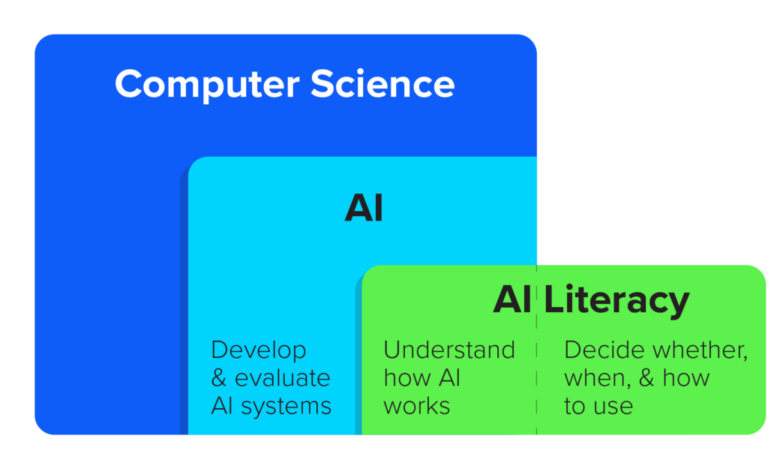
- Demystify How AI Works: Move past the “prompt engineering rat race”. Teaching the core mechanics, strengths, and risks of AI builds the critical thinking students need to bypass the hype and become responsible engineers.
Nurturing Human Flourishing We must focus on uniquely human skills that AI cannot replicate—like empathy, collaboration, and complex problem-solving. When machines handle syntax, students are freed to become “quintessentially human”.