Computer Science Gets Lost in Washington’s FutureReady Graduation Framework
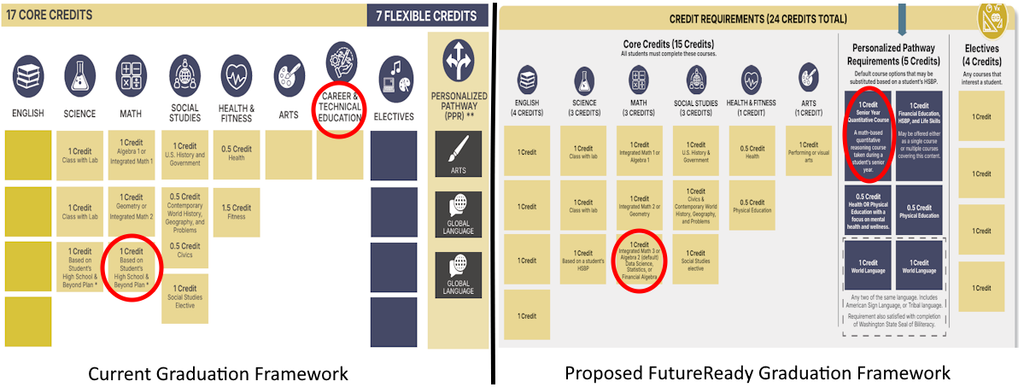
Washington is considering its most significant revision of high school graduation requirements in years. The proposed FutureReady State Graduation Requirement Framework promises students greater flexibility, stronger academics, and better preparation for life after high school.
But for computer science education, several parts of the proposal raise serious questions. In some cases, the proposed framework appears to reduce the explicit role that computer science has under Washington’s current graduation requirements.
Important: FutureReady is a proposal, not current graduation policy. The State Board of Education’s requested legislation will be considered by the Washington Legislature during the 2027 legislative session.
FutureReady was launched in summer 2024 as a multi-year initiative of the Washington State Board of Education to modernize graduation requirements while giving students greater flexibility to tailor their education to their goals.
On August 13, 2026, the Board approved the Washington FutureReady State Graduation Requirement Framework. On September 10, it approved agency-request legislation to comprehensively update Washington’s high school graduation requirements. That legislation is expected to go before the Legislature during the 2027 session.
For Washington’s computer science education community, several provisions need clarification before the Legislature acts.
“Technology” is not the same thing as computer science
The FutureReady resolution places computer science and related concepts under the broader term “technology.” It also calls for districts to provide instruction in “technology and media literacy at all grade levels in an interdisciplinary way.” However, neither the resolution nor the proposed legislation clearly defines what “technology” includes or provides detailed support or guidance for how districts should provide this instruction.
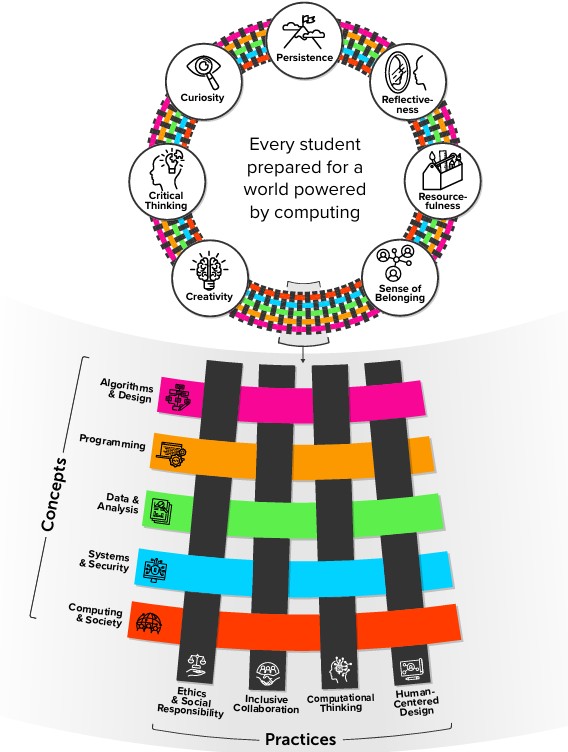
That distinction matters. Computer science is an academic discipline with its own standards, concepts, practices, and learning goals. Teaching students to use digital tools or understand media literacy is valuable, but it does not necessarily mean students are learning computer science.
If FutureReady is intended to strengthen students’ preparation for a world increasingly shaped by computing, the role of computer science should be explicit rather than assumed to be part of a much broader category called technology.
Most computer science courses may lose a route to satisfying third-year math
This may be one of the most significant changes for computer science in Washington.
Under current Washington guidance, computer science courses have considerable flexibility to count toward a core graduation requirement as a third-year mathematics or science course. RCW 28A.230.300 applies this flexibility to computer science courses identified in Appendix V of OSPI’s CEDARS database with Computer Science = Yes.
While the current graduation framework describes third-year mathematics as: “Based on Student’s High School and Beyond Plan.” The proposed FutureReady framework is much more specific. Third-year math is listed explictly as: Integrated Math 3, Algebra 2, Data Science, Statistics, Financial Algebra. Computer science is not listed.
The proposed legislation does continue to allow AP Computer Science to substitute for mathematics or science, but it does not distinguish between AP Computer Science A and AP Computer Science Principles, nor does it clearly guarantee that other computer science courses would continue to qualify.
What happens to the one-credit CTE requirement?
Computer science in Washington is closely tied to Career and Technical Education. Currently, approximately 85% of computer science courses in Washington are taught as CTE courses.
Under the current graduation framework students must earn one CTE credit to graduate. The FutureReady framework makes the status of that requirement unclear.
The framework graphic no longer identifies CTE as a separate required credit. At the same time, the Board’s resolution states: “At a minimum, one of a student’s 24 credits is expected to be a CTE course.” But that CTE credit does not appear as one of the 15 core credits or five personalized pathway credits shown in the framework. It is also not clearly identified within the four elective credits.
For computer science, this is not a minor bookkeeping issue. Because such a large share of Washington CS courses are delivered through CTE, changes to CTE graduation requirements could significantly affect computer science enrollment.
The FutureReady proposal also refers to efforts to “expand CTE opportunities and flexibility,” but exactly how those changes would affect computer science education remains unclear.
Students may have less reliable access to a computer science course
RCW 28A.230.300 and SB 5088 (2019) established the requirement that districts provide an opportunity for all high school students to access an elective computer science course.
The proposed legislation reduces that requirement to offering such a course “at least once in the four years” beginning with ninth grade.
That wording could have a very different practical effect. A computer science course offered only once every four years could technically satisfy the requirement while being unavailable to many students during most of their high school careers.
If Washington wants every student to have meaningful access to computer science, course availability needs to mean more than simply offering a class sometime during a four-year cycle.
Computer science was part of the FutureReady process
Computer science was not absent from the FutureReady development process.
Computer science, technology, and media literacy was one of the FutureReady Task Force’s designated focus areas. CSforAll Washington was tasked to develop recommendations for the FutureReady Graduation Requirements Task Force.
That makes the lack of clarity in the final framework particularly notable.
The other two FutureReady focus areas received much more explicit treatment.
- Personal finance, for example, is now included in a mandatory one-credit course along with the High School and Beyond Plan and life-skills instruction.
- Mathematics requirements are also much more specifically defined. Instead of allowing third-year mathematics to depend broadly on the student’s High School and Beyond Plan, FutureReady names the courses that satisfy that requirement. Further, one of the five personalized pathway credits is “a math-based quantitative reasoning course taken during a student’s senior year.” Whether computer science meets either the criteria for a third or fourth year course is unclear.
Conclusion
FutureReady is intended to prepare Washington students for their futures.
In a state whose economy—and nearly every field of study and employment—is increasingly influenced by computing, computer science should not be left to implication.
It should be clearly and intentionally included in Washington’s graduation framework.