2026 PK-12 CS Standards: Concepts, Practices, and Dispositions
This is the third in a series of posts about the 2026 PK-12 CS standards. For the full list of articles in this series, see the list at the bottom of this post.
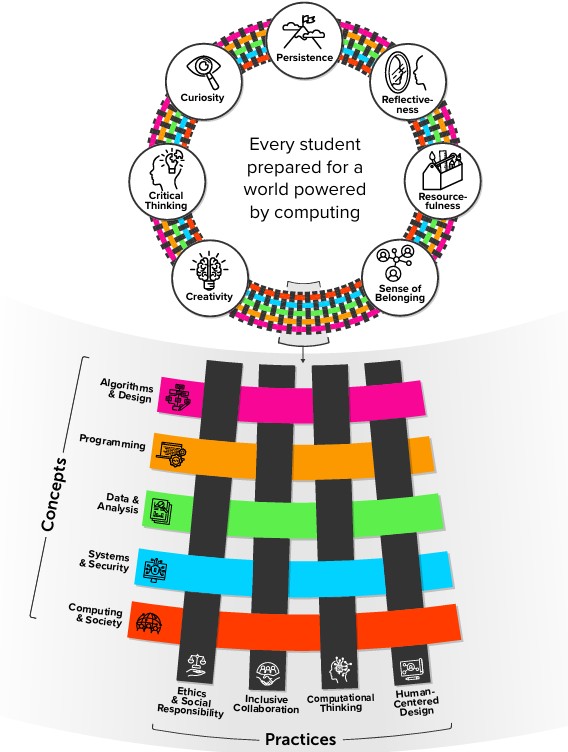
The 2026 PK-12 CS standards use three interacting components:
|
Concepts |
What students know |
Algorithms & Design, Programming, Data & Analysis, Systems & Security, and Computing & Society |
|
Practices |
What students do |
Ethics & Social Responsibility, Inclusive Collaboration, Computational Thinking, and Human-Centered Design |
|
Dispositions |
How students approach their learning |
curiosity, creativity, persistence, reflectiveness, resourcefulness, critical thinking, and a sense of belonging |
The snapshot below is an example how concepts, practices, and dispositions are used to classify each standard.

The snapshot above shows a 5th-grade standard that covers
- The concept “Algorithms & Design” and the sub-concept “Algorithmic Problem Solving” listed at the top
- The practice “Computational Thinking” with sub-practices “Define computational programs” and “Develop and use abstractions” listed at bottom right
- The dispositions “creativity” and “critical thinking” listed at the bottom left.
One can filter on any top-level concept, practice, or disposition with the online version of the PK-12 CS Standards.
This bears a family resemblance to NGSS, which integrates disciplinary core ideas, science and engineering practices, and crosscutting concepts within three-dimensional learning. The CSTA structure, however, gives student dispositions and belonging an explicit place in the standards architecture. NGSS’s third dimension is a set of ideas that cut across scientific disciplines; CSTA’s dispositions describe the habits and identities students should develop through participation in computer science.
That distinction matters. “Sense of belonging” is not tucked into an introductory equity statement and then politely forgotten. It is treated as an outcome that should be intentionally developed and associated with individual standards. The following snapshot shows the four 2nd grade CS standards associated with “Sense of belonging”.

By the Numbers
The following table shows how many of the 196 foundational computer science standards cover each of the five foundational concepts:
|
Foundational Concept |
Standards |
|---|---|
|
Algorithms and Design |
40 (20%) |
|
Programming |
45 (23%) |
|
Data & Analysis |
35 (18%) |
|
Systems & Security |
38 (19%) |
|
Computing & Society |
38 (19%) |
The following table shows how many of the 196 foundational computer science standards cover each of the four practices. One standard can cover multiple practices:
|
Practices |
Standards |
|---|---|
|
Ethics & Social Responsibility |
77 (39%) |
|
Inclusive Collaboration |
92 (47%) |
|
Computational Thinking |
117 (60%) |
|
Human-Centered Design |
48 (24%) |
The following table shows how many of the 196 foundational computer science standards cover each of the seven dispositions. One standard can cover multiple dispositions:
|
Disposition |
Standards |
|---|---|
|
Creativity |
20 (10%) |
|
Critical Thinking |
151 (77%) |
|
Curiosity |
45 (23%) |
|
Persistence |
27 (14%) |
|
Reflectiveness |
100 (51%) |
|
Resourcefulness |
22 (11%) |
|
Sense of Belonging |
18(9%) |
Explore the 2026 CSTA Standards
This article is part of CSTA Washington’s series examining the new CSTA PK-12 CS Standards and their impact on Washington state. Articles in this series:
- Introducing the 2026 CSTA PK–12 Computer Science Standards: What Washington Educators Need to Know July 24, 2026
- 2026 PK-12 CS Standards: Foundation and Specialty Learning Aug 4, 2026
- 2026 PK-12 CS Standards: Concepts, Practices, and Dispositions Aug 11, 2026
- 2026 PK-12 CS Standards: A Sociotechnical Approach Aug 27, 2026
- 2026 PK-12 CS Standards: Elementary Standards for Each Grade Level Sep 2, 2026
- 2026 PK-12 CS Standards: AI as a Part of CS Sep 8, 2026
- 2026 PK-12 CS Standards: Value-Add Interactive Web Version Sep 18, 2026