Introducing the 2026 CSTA PK–12 Computer Science Standards: What Washington Educators Need to Know
At the 2026 CSTA Annual Conference in New Orleans, the Computer Science Teachers Association (CSTA) officially released the 2026 CSTA PK–12 Computer Science Standards. These are the first major revision of the standards since 2017, and they reflect how dramatically computer science education has evolved over the past decade.
Written by teachers for teachers, the 2026 CSTA PK-12 Standards offer flexibility and guidance to support state and local adaptation while also promoting instructional coherence across the United States and globally. Like previous versions, they define what students should know and be able to do, but they do not prescribe specific curriculum, instructional materials, or assessments.
Introducing Our 2026 CS Standard Series
Rather than trying to summarize the 218-page standards document and accompanying website in a single article, CSTAWA.org will explore the most significant changes through a series of focused posts. These will be linked below when they are published:
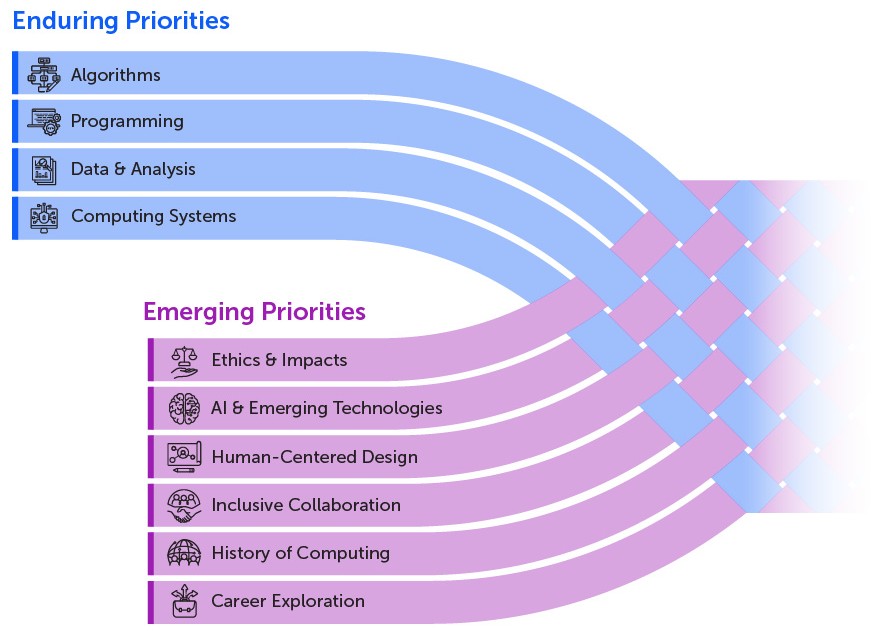
- Division of computer science into “foundational” and “specialty” standards with additional options to integrate computer science into other subjects
- Use of three interacting components: concepts – what students know; practices – what students do; and dispositions – how students approach learning
- Ethics, societal impacts, accessibility, and human-centered design are embedded throughout the discipline
- Artificial intelligence concepts are woven throughout the foundational standards; AI is also a specialty pathway.
- Elementary standards are more granular with expectations for each grade level.
- An interactive web version adds filters and search, detailed boundaries, practices, and dispositions, implementation examples, interdisciplinary connections, AI integration, instructional resources, and downloadable CSV and PDF exports.
Learning the New Standards
To help educators learn more about the standards and how to implement them, CSTA is also providing two online professional development courses that are free to CSTA members:
- CSTA 2026 PK-12 Standards: An Introduction (~2 hours), and
- Using The CSTA Standards for CS Teachers To Improve Practice (~8 hours).
Stay tuned for information regarding the availability of Washington clock hours for completing of these courses.
The complete 218-page PDF of the standards is available free from CSTA, and printed copies (approximately $21) of the standards and other resources may also be purchased through the CSTA website.
Why This Matters for Washington
The 2026 CSTA standards are less like a conventional checklist of computer science topics and more like a national architecture for computer science education. The CSTA standards describe what students should know and be able to do, but explicitly do not prescribe curricula, instructional materials, or assessments. They are designed for flexible state and local adaptation.
Unlike a state-led standards initiative accompanied by a synchronized adoption campaign or assessment system, these computer science standards will spread through state revisions, district decisions, curriculum development, teacher preparation, and professional learning.
Washington is expected to adopt new K–12 computer science standards by the end of the 2026–27 academic year. Because our current Washington standards closely mirror the 2017 CSTA Standards, the newly released 2026 standards are likely to play a major role in shaping the next generation of computer science education across our state. But what happens with computer science education in our state will not depend so much on what these new Washington computer science standards are, but on how CS educators statewide decide to implement these new CSTA 2026 PK-12 Standards in our districts and schools.