2026 PK-12 CS Standards: AI as a Part of CS
This is the sixth in a series of posts about the 2026 PK-12 CS standards. For the full list of articles in this series, see the list at the bottom of this post.
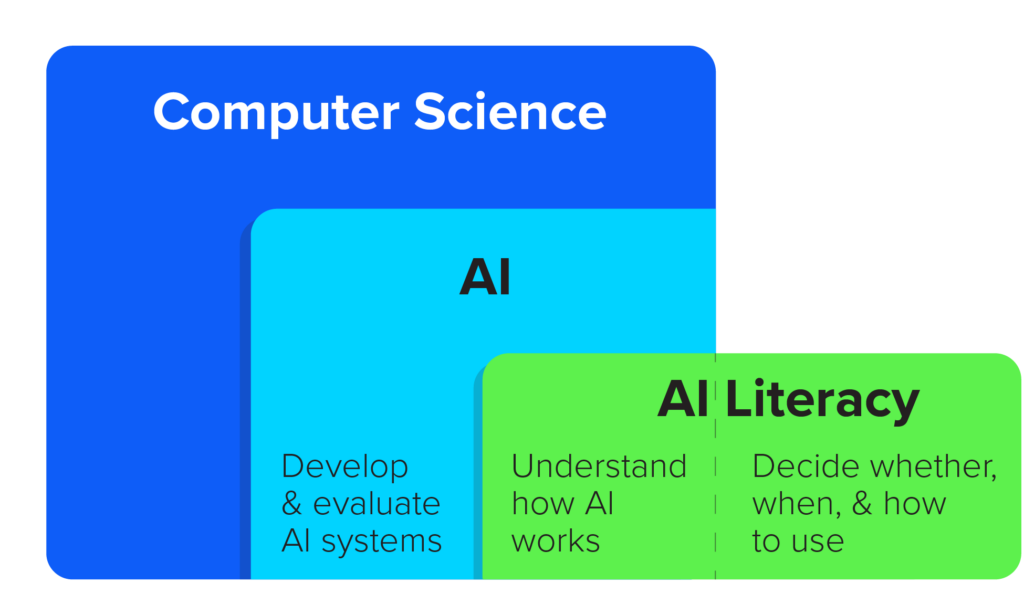
In addition to providing standards for specialty high school AI (artificial intelligence) courses, the 2026 PK-12 CS Standards also integrate AI content throughout the 196 foundational standards. Because AI technologies are built upon foundational computer science principles, AI learning is integrated throughout the standards rather than defined as a separate concept.
Standards containing explicit or foundational AI learning are tagged as AI-related in the interactive version. While there are explicit callouts to subconcepts such as “machine learning” and terms such as “AI”, “training”, and “bias” are mentioned in many of the AI-related standards, why a particular standard is AI-related is not explicitly explained in all of the “AI-related” standards.
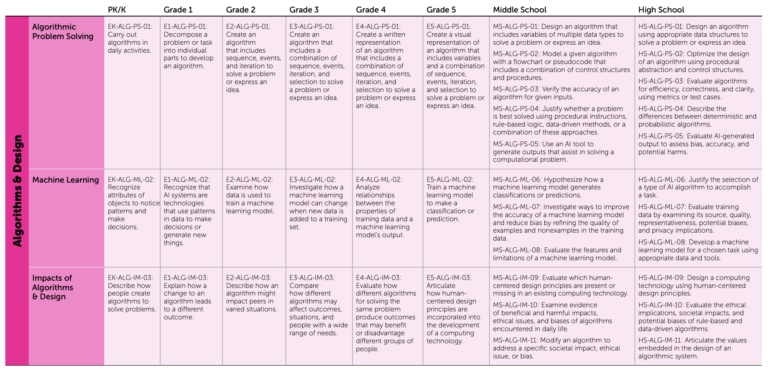
CSTA also provides a document showing how AI-related standards progress across PK-12.
This is structurally different from simply adding an “AI unit” to an existing standards document. The standards approach argues that students cannot understand AI without an understanding of algorithms, data, programming, systems, and computing and society—and that those foundational areas can no longer be taught honestly while pretending AI does not exist.
By the Numbers
Of the 196 foundational computer science standards, 79 (40%) are tagged as AI-related. The number of AI-related standards of the 196 foundational computer science standards are distributed among the five foundational concepts as follows:
|
Foundational Concept |
AI Content |
Total Number of Standards |
AI-related Standards |
Percentage |
|---|---|---|---|---|
|
Algorithms & Design |
Rule-based vs. data-driven approaches, machine learning, and societal impacts (e.g., bias) |
40 |
25 |
62% |
|
Programming |
Reading and evaluating AI-generated code |
45 |
2 |
4% |
|
Data and Analysis |
Data fluency and societal impacts (e.g., large-scale data collection) |
35 |
8 |
23% |
|
Systems and Security |
Security implications and environmental impacts |
38 |
9 |
24% |
|
Computing & Society |
History of computing and AI, emerging technologies, the relationship between humans and AI, and how people decide when and how to use these technologies responsibly |
38 |
35 |
92% |
The number of AI-related standards of the 196 foundational computer science standards are distributed by grade-band as follows:
|
Grade band |
Total Number of Standards |
AI-related Standards |
Percentage |
|---|---|---|---|
|
PK-2 |
48 |
10 |
21% |
|
3-5 |
57 |
24 |
42% |
|
6-8 |
45 |
22 |
49% |
|
9-12 |
46 |
23 |
50% |
The above table shows the number of elementary standards by grade band to provide an overview. The actual CSTA standards specify standards for each elementary grade level (see 2026 PK-12 CS Standards: Elementary Standards for Each Grade Level) to better support elementary schools in implementing the standards.
The above tables do not consider the AI content in the 135 specialty standards for courses in Artificial Intelligence, Cybersecurity, Data Science, Game Development, Physical Computing, and Software Development that high school students may take after completing computer science coursework in the foundational standards. To learn more about these specialty standards to better prepare students for preparing students for postsecondary coursework, industry certifications, or continued specialization in computer science, see Foundation and Specialty Learning.
To see the list of the 24 standards for the Artificial Intelligence specialty, see the Standards Interactive Dashboard with the Artificial Intelligence specialty standard filter set.
Explore the 2026 CSTA Standards
This article is part of CSTA Washington’s series examining the new CSTA PK-12 CS Standards and their impact on Washington state. Articles in this series:
- Introducing the 2026 CSTA PK–12 Computer Science Standards: What Washington Educators Need to Know July 24, 2026
- 2026 PK-12 CS Standards: Foundation and Specialty Learning Aug 4, 2026
- 2026 PK-12 CS Standards: Concepts, Practices, and Dispositions Aug 11, 2026
- 2026 PK-12 CS Standards: A Sociotechnical Approach Aug 27, 2026
- 2026 PK-12 CS Standards: Elementary Standards for Each Grade Level Sep 2, 2026
- 2026 PK-12 CS Standards: AI as a Part of CS Sep 8, 2026